Showing posts with label Osama bin Laden. Show all posts

Friday, May 6, 2011

What Price Gory?

The recent debate about whether or not to release the gruesome images of Osama bin Laden's bloody corpse raises two interesting questions that are especially important during wartime:

1. Who owns the dead?

2. What do the dead mean?

President Obama implied the answer to both questions when he announced the decision to not release the photographs: "That's not who we are. We don't trot this stuff out as trophies."

One of many t-shirts designs available.
In this case, the photographs of bin Laden's body are a sign of ownership, since one cannot trot out a trophy one does not own.  The photographs prove that he had been killed and that the United States had his body in its possession -- before sending it, Sopranos-style, to the bottom of the sea.  

And calling bin Laden a trophy suggests his meaning: His body is a sign of victory, a reward for a great effort.  As a trophy, the body (or the photographs that now stand in for it) can build the morale of the "home team."  It can build support for a continued war effort.  Alternatively, the trophy is a sign that the game is over and it is time to go home.  A trophy also can be used as sign of humiliation of the opponent, especially if it is displayed so that the enemy can see it.  .

Bin Laden's death means one contest is over, but another contest has begun: What will bin Laden's body mean now?  Although the United States took possession of him, it is not entirely free to determine what his body means.

Elaine Scarry thought a lot about what healthy, wounded, and dead bodies mean in wartime.  She wrote about this in her book The Body in Pain: The Making and Unmaking of the World.  She wrote that the soldier's living body means what he claims it to.  It substantiates what he believes in.  He is willing to kill others for that cause.  He is willing to die for that cause.

But once he is wounded or killed, the meaning of his body is no longer his to determine.  Once he is wounded or killed, the opponents can now use him as evidence of their victory.  We have seen descriptions of famous battles that list the numbers of killed and wounded for each side.  In most cases, according to Scarry, the side that suffers the most killed and wounded is deemed the loser, so the winner claims those bodies like points scored in a game.

Before those soldiers were wounded or killed, they were the enemy and they substantiated nothing about their opponent's cause.  After the battle, the wounded or killed soldier can be claimed by both sides.  His own side can claim his sacrifice as ennobling its cause, but the opposition can claim his wounds as evidence of its victory.

Scarry called this the "fluidity of the injured body's referential direction" and the body's "referential instability"  (yes, it is a rather philosophical and academic book).

The "referential instability" of bin Laden's body is evident when we consider the reasons for and against releasing the photos.

The Americans might want to release photos of bin Laden's body to confirm his death to doubters.  Or they might want to release the photos to share the victory with those who had been seeking it for so long -- the sports equivalent would be the Green Bay Packers displaying the Super Bowl trophy during its homecoming parade.  But releasing the photos might make it easier for al-Qaeda members to claim his body means "martyrdom," and they could claim his body means "we should keep fighting to honor his sacrifice."  This would especially be true since bin Laden's body is apparently bloody and battered in the photographs; his wounds that can signify "victory" against a reviled enemy of the United States also can signify "injustice" committed against the revered leader of al-Qaeda.

The difficult nature of this contest was emphasized when the United States decided to drop his body into the ocean.  The military wanted no grave on land that could become a pilgrimage point for bin Laden's followers.

  +   +   +

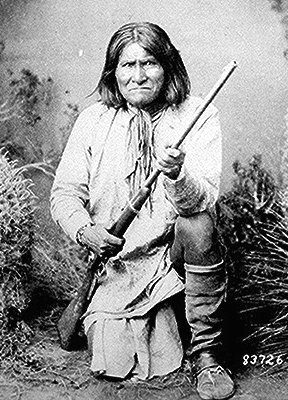
Considering the question of "Who owns the dead?" brings me back to the Geronimo code word controversy.  That controversy involves many perspectives, inside and outside of Indian Country.  Some people feel that using "Geronimo" in the mission that killed bin Laden was evidence of persistent racism from the United States military and in society in general.  Others feel it was a compliment for the U.S. military to use the name of an enemy leader it once sought to kill.  Others feel it is the vestige of the American mythology of "Cowboys vs. Indians," of Civilization vs. Savagism.  Regardless, the simple fact that the U.S. military felt free to use the name showed an attitude of ownership.  The debate of the past few days shows how, 100 years after his death, Geronimo, as a defeated enemy of the United States, is marked by the "referential instability" that Scarry describes.

Geronimo's "referential instability" is evident by his presence (far right) on this t-shirt that has been popular for about as long as the United States had been hunting bin Laden.  At the same time Geronimo's name was used as a code word in a long-awaited and very successful strike against terrorism, his image is used to appropriate and mock the familiar language of American national security and history.

Tuesday, May 3, 2011

Geronimo? Really?

No wonder Osama bin Laden was hard to find -- he was hiding in Vietnam.

In 1968.

Graphic novel by Don Lomax
During the Vietnam War, soldiers from the United States referred to areas controlled by the Viet Cong or the North Vietnamese Army as "Indian Country."  The fighting itself was called "playing Cowboys and Indians."

Imagine if you were an American Indian serving in the U.S. military in Vietnam.  Playing this "game" meant you were fighting yourself.

In one sense, "Cowboys and Indians" was an extension of the games the soldiers had played in their youth back home.  Those games were played in imitation of the Western movies those boys had watched in theaters and on television.  Those Westerns were a continuation of one of the fundamental stories in American culture: the encounter between the Europeans and the American Indians.  In its most simplistic terms, this encounter was (mis)understood as a battle between Civilization (the Europeans) and Savagism (the Indians).

I thought we had moved beyond that this simplistic myth.  But I was wrong.

Geronimo
I write that because Osama bin Laden's code name for his assassination mission was "Geronimo."  Navy SEAL Team Six seemed to be playing Cowboys and Indians in the Pakistani resort town of Abbottobad.  Their target was named after the famous Apache leader/warrior who is rivaled by only Crazy Horse and Pocahontas as the most famous Indian in United States history.

Or their mission, and not their target, was named "Geronimo."  The White House has told conflicting stories.

Regardless, the Internet in Indian Country has been busy with folks registering their surprise, dismay, or anger with the mission's vocabulary.  You can see some of the reactions here, here, and here.  Also, my friend Debbie Reese, who blogs about American Indians and children's literature, has written about it (here).

Fortunately, the staff director for the Senate Indian Affairs committee has voiced objections to using Geronimo's name in this way.
Sikorsky Black Hawk

There is a long history of the U.S. military using American Indian names to identify many things.  For instance, the helicopters used to transport soldiers into bin Laden's compound were Black Hawks, named after a Sauk and Fox leader who fought against the United States in 1832.  Imagine the irony if the United States had sent in its most famous attack helicopters -- the Apache -- to kill "Geronimo."

I understand the inclination to
Boeing Apache
call Osama bin Laden "Geronimo." Like Geronimo, he was involved in armed resistance against the U.S. military.  Like Geronimo, he frustrated the U.S. military with his abilities to evade capture.  Like Geronimo, he had become a daunting adversary.

But unlike Osama bin Laden, Geronimo was not famous for killing thousands of civilians.  Unlike Osama bin Laden, Geronimo was a member of a community that is now part of the United States.  Unlike Osama bin Laden, Geronimo may have descendants who are now serving in the U.S. military.

So Apache people are puzzled when one of their historical and cultural heroes is chosen as the namesake for a reviled enemy.  And American Indians are puzzled when they see that the "Cowboys and Indians" narrative is still alive in American culture -- especially in President Obama's White house. 

Back in November, 2009, Obama told a gathering of American Indian leaders: "I know what it means to feel ignored and forgotten, and what it means to struggle.... So you will not be forgotten as long as I'm in this White House."

Many American Indians feel forgotten when such a code name is used.  I am sure whoever came up with the code name was not thinking of its implications in this regard.  That person was being swept up in a narrative older and bigger than himself.  But not thinking about its implications shows to what degree American Indians are absent in the national consciousness and conscience.  American Indians feel forgotten when they find themselves represented as savages again.  As "the bad guys" again.  As the target again.

From TPapi's Photostream on Flickr.com
The list of possible code names is endless, which makes the choice of "Geronimo" so telling.  Osama bin Laden could have been The Rabbit or The Fox, since he was so hard to catch or so crafty.  Personally, I like The Mole, because pursuing him could have been compared to playing Whack-a-Mole at the arcade. 

He could have been called Tickle-Me Elmo, for all I care.  The point is moot now, since he is dead. 

But next time, the U.S. military should remember that American Indians are American citizens and have been for a long time.  "Cowboys and Indians" is a game for the past.  Let's not play it anymore.

Note: Since this was originally posted, we have learned that the Navy SEALs may have used a "stealth" helicopter in the attack, rather than a Black Hawk.  Also, President Obama, in an interview on 60 Minutes, stated that "Geronimo" was the code name for bin Laden; not the code name for the whole mission.